Note 02 · The comparison
Comparing deposition methods without shortcuts
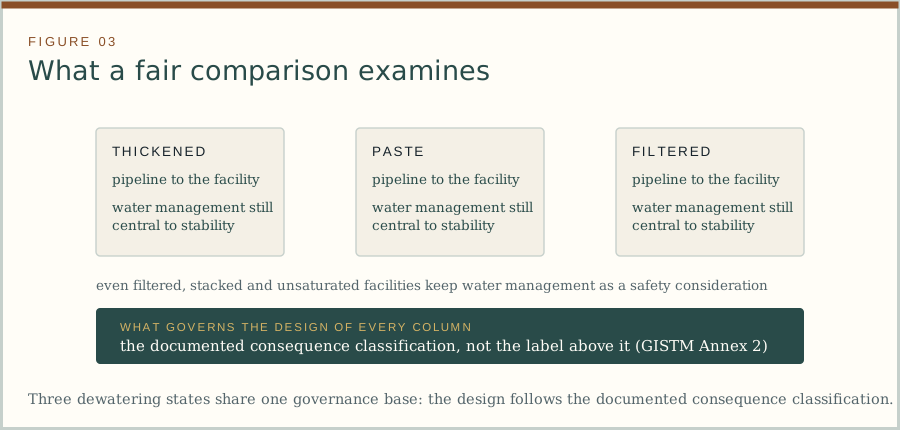
Thickened, paste and filtered name states of one material stream. Comparing them fairly means comparing transport, water and governance, not adjectives.
Why method labels mislead
The three words sit on a single scale. The ICMM guide asks whether tailings “will be dewatered to some degree and managed as thickened, paste or filtered tailings”, so a label tells you how far along that scale the material sits. It does not tell you that one position on the scale is safer than another. In every document this desk reads, safety is a property of design, operation and governance for a specific place.
The scale itself is not mysterious. What changes between states is the water that remains and the machinery that handles it, and both of those are engineering facts about a specific stream, not virtues a brochure can borrow by naming them.
A comparison that crowns a winner in the abstract is therefore not comparing methods at all; it is comparing slogans. The honest version starts lower, with what each state changes in practice.
What each label changes first: transport
The clearest practical difference the public guidance records is logistical: “a pipeline in the cases of slurry, thickened or paste tailings, and truck or conveyor belt in the case of filtered tailings”. Pumps and pipes on one side, trucks and conveyors on the other: different equipment, different costs, different operating disciplines and different failure modes.
This is also why the guide’s closure planning list pairs the moisture decision with the physical characteristics of the tailings and calls both essential to the plan. How the material behaves and how it travels are decided together, and a comparison that separates them has already simplified itself past usefulness.
Does dewatering end water management?
The ICMM guide answers that question plainly. Water management, it says, “is an important aspect in safety and stability considerations for all surface disposal tailings facilities. This is true even for facilities where the tailings have been filtered and are unsaturated, with the tailings stacked and no water storage pond associated with the tailings facility”.
The same passage continues: “many credible failure modes for tailings facilities are rooted in water management and the presence of water exacerbates the consequences of a potential failure even if water is not an initial failure trigger”. A comparison that treats dewatering as the end of the water question has stopped reading one paragraph too early. Runoff, seepage and the water balance of the whole site remain part of the safety argument for every state on the scale.
What the Standard asks instead of a favourite method
Annex 2 of the Standard publishes a consequence classification matrix that grades a facility by potential population at risk and potential loss of life, from Low up to Extreme. Requirement 4.3 then asks the Accountable Executive to “take the decision to adopt a design for the current Consequence Classification criteria and to maintain flexibility to upgrade the design”, and to document that decision.
Requirement 4.4 adds that design criteria must be selected and documented “to minimise risk for all credible failure modes for all phases of the tailings facility lifecycle”. The comparison the Standard wants is consequence-driven and written down, not label-driven. Where a document ranks methods without naming the classification context, it has replaced an engineering question with a marketing one.
Which questions survive any comparison
Three, at minimum. What knowledge base stands behind the numbers: Principles 2 and 3 require an interdisciplinary base, social and environmental as well as technical, used to inform decisions through the lifecycle. What monitoring will test the assumptions: Principle 7 requires monitoring systems at all phases, closure included. And who reviews performance over time: Requirement 10.5 sets independent Dam Safety Reviews at least every five years for facilities classified Very High or Extreme, and at least every ten years for all others.
A method claim that cannot answer those three questions has not yet been compared. It has been advertised, which is a different activity with different obligations.
A fourth question is worth keeping in view: what would change the answer. Requirement 4.2 has the consequence classification itself revisited at the Dam Safety Review and at least every five years, or sooner if there is a material change in the social, environmental and local economic context, wherever the adopted design must stay upgradeable, and the Standard applies the same review to existing facilities, subject to Requirement 4.7. A comparison frozen in time is a comparison already aging.
How to read any method comparison, including this one
Treat every table, this site’s included, as a map of questions rather than a verdict. The decisive documents for a real facility are its design basis, its consequence classification and its monitoring record, held together by named accountable people. The review questions are collected in the fourth note of this series, and the third note shows the plan in which those documents are supposed to meet.
Sources used for this note
- ICMM, Tailings Management: Good Practice Guide, May 2021: closure planning list (closure chapter); water management chapter on filtered and unsaturated facilities.
- Global Industry Standard on Tailings Management, August 2020: Annex 2 consequence classification tables; Requirements 4.3, 4.4 and 10.5; Principles 2, 3 and 7.
Editions, links and the desk’s citation practice are described on the sources page.
Published September 6, 2026 by the Thickened Ground Notes desk. A reading guide, not engineering advice.