Note 01 · The term
What thickened tailings means
A plain-language account of what the word names, what it does not name, and why that distinction matters whenever someone quotes it.
What are tailings, before any adjective?
The ICMM guide opens its context chapter with a definition this desk quotes willingly: tailings are “a by-product of mining, consisting of the processed rock or soil left over from the separation of the commodities of value from the rock or soil within which they occur”. The Global Industry Standard on Tailings Management carries the same wording in its glossary. Nothing in that definition is alarming by itself; it describes a leftover, not a hazard.
What makes the leftover matter is management. The same ICMM chapter records that if tailings are not managed in a safe and responsible manner they can pose risks to the environment, human health and infrastructure, and that failures over the last decades have included fatalities, displacement of communities, damage to infrastructure, and loss of ecosystems and habitat. That history is why an entire family of public documents exists, and why this desk reads them closely rather than settling for adjectives.
What does thickened actually describe?
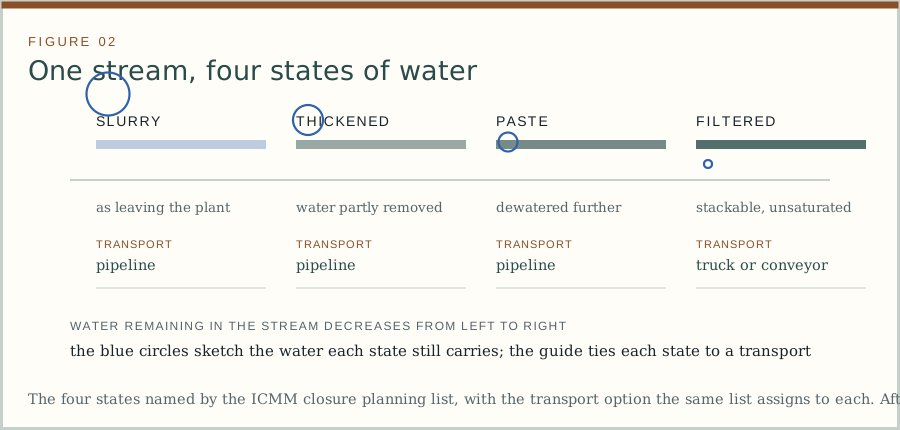
In its closure planning chapter, the ICMM guide asks whether “the tailings will be managed as slurry, or whether they will be dewatered to some degree and managed as thickened, paste or filtered tailings”. Thickened is the second state on that scale: material from which a degree of water has been removed after processing. The guide immediately adds that “the planned moisture content and the physical characteristics of the tailings are essential to the plan”.
The word therefore names a process state, not a material, a landform or a level of risk. Two facilities both described as thickened can differ in mineralogy, in particle sizing and in the water they still carry, and the ICMM guide treats those differences as decisive for planning rather than as passing detail. A reader who meets the word without a moisture figure has met half a sentence.
How does the material travel?
The same closure planning list ties each state to a way of moving: “Options include a pipeline in the cases of slurry, thickened or paste tailings, and truck or conveyor belt in the case of filtered tailings”. Transport is where the dewatering decision first becomes visible on the ground: a pipeline answers a flowable stream, while a truck or a conveyor answers a stackable one.
For a reader comparing claims, that pairing is a useful anchor. It is one of the few places where the public guidance attaches a concrete, checkable arrangement to each word of the scale, and it costs nothing to ask any description the same question: how does the material actually reach the place where it will rest.
Is thickened one material with one behaviour?
No, and the guidance says so structurally rather than rhetorically. Principle 2 of the Standard requires operators to “develop and maintain an interdisciplinary knowledge base” throughout the tailings facility lifecycle, precisely because the material, the site and the surrounding social and environmental context vary from place to place. A moisture value measured in a laboratory is an input to that knowledge base, not a conclusion from it.
Principle 3 extends the point: all elements of the knowledge base, “social, environmental, local economic and technical”, are to inform decisions across the lifecycle. The practical reading for a non-engineer is simple. Ask what was measured, on which sample, at which time, and how the answer is kept current as the facility operates and the feed changes.
What can the word itself never promise?
The preamble of the Standard states that it “requires Operators to take responsibility and prioritise the safety of tailings facilities, through all phases of a facility’s lifecycle, including closure and post-closure”. A description of how much water was removed does not carry that responsibility; governance does. Calling material thickened cannot, on its own, demonstrate stability, reduced consequence or environmental performance.
The same preamble adds that the Standard “provides a framework for safe tailings facility management while affording Operators flexibility as to how best to achieve this goal”. That flexibility is exactly why one label can sit on very different levels of care. The word is the beginning of a question about a specific facility, never the answer.
How should a reader use the word?
Use it as a pointer, then verify what stands behind it: which moisture content is planned, which physical characteristics were measured, which monitoring will show whether the deposit behaves as expected, and who holds the design basis. Principle 7 of the Standard asks for monitoring systems “to manage risk at all phases of the facility lifecycle, including closure”, and Principle 9 asks for an appointed, empowered Engineer of Record.
The next note applies the same discipline across the whole family of labels, from thickened to filtered, and the note on deposition plans shows where the answers are supposed to be written down and kept current.
Sources used for this note
- ICMM, Tailings Management: Good Practice Guide, May 2021: context definition and risks (Section 1.1.1); closure planning list with moisture content and transport options (closure chapter).
- Global Industry Standard on Tailings Management, August 2020: preamble; Principles 2, 3, 7 and 9; glossary definition of tailings.
Editions, links and the desk’s citation practice are described on the sources page.
Published September 6, 2026 by the Thickened Ground Notes desk. A reading guide, not engineering advice.